
Ignoring Correct AI Advice Hurts Accuracy
In a 125-reader, 50-case head CT study, ignoring correct AI advice hurt performance more than following wrong advice. Explainable AI helped accuracy, not speed.
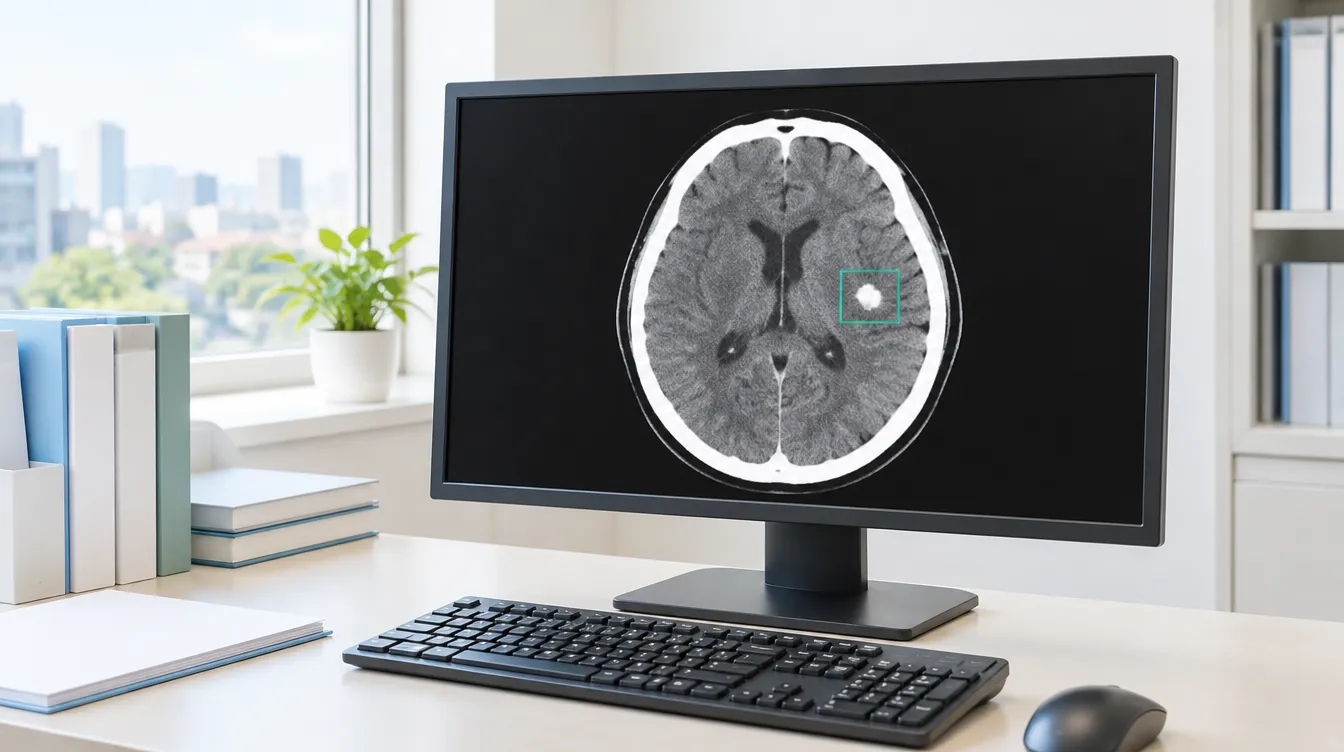
The three points
- Ignoring correct AI advice lowers accuracy. The 50-case, 125-reader head CT experiment found under-reliance at 11% to 21% and over-reliance at 27% to 58%. Because 80% of advice was correct, under-reliance affected more cases.
- Explainable AI helps when readers are uncertain. Correct explainable advice raised accuracy (OR 1.84) and confidence, especially on difficult hemorrhage cases. It did not shorten reading time.
- It does not stop active rejection. Some readers still dismissed correct advice. An interface that only asks for agree or disagree also invites misclicks.
Correct AI advice only helps if readers use it. A randomized crossover experiment with 125 readers measured how often that happened, and how it compared with following wrong advice. The results appeared in Lancet Digital Health on October 23, 2026.
The experiment
The study ran from February 16 to August 10, 2023, with 125 participants from 10 countries: 50 radiologists (mean experience 7.85 years) and 75 non-radiologists or medical trainees (0.17 years).
Each participant read 50 head CT cases: 25 with intracranial hemorrhage and 25 without. The set included 10 easy, 20 medium, and 20 hard cases. Every reader reviewed the same cases in three sessions, at least 14 days apart. The sessions used three conditions: no AI advice, a basic AI prediction, and an explainable prediction with a bounding box around the suspected hemorrhage. The order was randomized.
Eighty percent of the advice was correct; 20% was wrong. Wrong cases were balanced between false negatives and false positives. A total of 111 participants completed all three sessions.
Under-reliance and over-reliance
Over-reliance, meaning following wrong advice, ranged from 27% to 58%. Under-reliance, meaning dismissing correct advice, ranged from 11% to 21%. By percentage alone, over-reliance looks more common.
But 80% of the advice was correct, so under-reliance affected more cases. Removing under-reliance would have improved accuracy by 5 percentage points for experts given basic advice, 4 points for experts given explainable advice, and 5 points for novices given basic advice. The exception was novices given explainable advice, where over-reliance had a larger effect (-1 point).

Under-reliance clustered in hemorrhage-positive and difficult cases. Explainable AI cut under-reliance when the scan showed a hemorrhage and the AI agreed. It produced a small increase in over-reliance when the scan was negative and the AI claimed a hemorrhage.
What explainable AI changed, and what it did not
Baseline accuracy was 63% for novices and 83% for experts. Correct advice raised accuracy in both groups. Explainable advice produced the only significant gain for experts; novices also improved with basic advice.
Correct explainable advice raised accuracy (OR 1.84, 95% CI 1.49 to 2.28, p<0.0001) and confidence (b=0.15, 0.09 to 0.22, p<0.0001) compared with no advice. The gain was largest on difficult hemorrhage cases. It did not shorten reading time (b=-1.81, -3.78 to 0.16, p=0.071). Correct basic advice reduced reading time, but the effect came from experts; novices took longer on hemorrhage-positive cases.
Think-aloud transcripts from novices showed four patterns of under-reliance: medical uncertainty that made the advice or box hard to verify; distrust, suspected system errors, or an alternative explanation; ignoring the AI after a perceived past error; and, on negative cases, agreeing with the no-hemorrhage advice but clicking hemorrhage by mistake. Under-reliance came with longer reading time and lower confidence.
Explainable AI cut the first pattern, the uncertainty-driven misses. It did not reduce active rejection, the second and third patterns.
Eye tracking showed a similar split. When experts rejected correct explainable advice on a hemorrhage case, they looked at the bleeding area more than anywhere else, and also scanned other regions. They saw the evidence, hesitated, and rejected it. When they rejected correct basic advice, they looked at the bleeding area in few cases and searched elsewhere.
The share of cases with no fixation on the bleeding area was 38% (17/45) with correct basic advice and 67% (18/27) with incorrect basic advice. With explainable advice, it was 3% (1/37) when the advice was correct and 65% (13/20) when it was wrong.
What this means in practice
As AI accuracy rises, correct advice becomes more common. The risk of under-reliance grows with it. The authors argue that countermeasures should target reliance on correct advice, and also over-reliance on wrong advice.
Explainable AI is not a cure. It can add reading time, and it does not stop readers who distrust the system. The authors discourage interfaces that only ask clinicians to agree or disagree with AI output, because misclicks become a source of under-reliance. They call for usability testing.
For Japanese hospitals, the practical lesson is to avoid a binary read-or-ignore choice. Log when a reader dismisses a candidate and why. Later review can separate a correct override from a missed finding.
Limitations
The experiment ran online, fixed AI accuracy at 80%, and used a single imaging task with a binary decision. Real AI varies in accuracy and error type, and the study did not cover report writing or multiple findings.
The case mix oversampled difficult and hemorrhage-positive scans, so it does not match clinical prevalence. Memory of earlier cases may still bias answers despite the two-week washout. The expert group included early-career radiologists, and think-aloud or eye-tracking participation may have changed behavior.
Research note: Published online in Lancet Digital Health on October 23, 2026. Randomized crossover experiment. Funded by the Volkswagen Foundation, the Forum for Interdisciplinary Research, and the German Federal Ministry of Education and Research. Conflicts of interest are disclosed in the paper. Data are available on OSF.
Sources
- [1]
- [2]
- [3]
Images: generated with GPT Image 2.5 (illustrative).